Showing posts with label Listening lessons. Show all posts

Music du Jour

Hello everyone! This is Tanya LeJeune from Teaching Music: Tanya's Kodály Aspiring Blog.

I feel like I'm always striving for balance of activities in my music room. In a perfect world, during every lesson my students would work on melodic and rhythmic concepts, practice ensemble work with and without instruments, dance, create in self-directed groups, listen to excellent music, and engage in higher level thinking through thoughtful questioning. Often, I'll look at my long-range plans and think, "I'm not on-track with the 3rd graders, and they haven't learned a folk dance for quite a while!" or "I need to make sure I get that 5th grade listening lesson in before Halloween!"

One of my goals this year is to include more listening in my lessons. My students are simply not exposed to a variety of music outside of the music room, unless it's pop or hip hop. It's wonderful that they listen to music at all as I believe that any music listening eventually leads to more listening of other genres. It's my responsibility to broaden students' music listening and expose them to genres they might not encounter outside of the music room. (Have you ever played a orchestral piece for young students and had several remark, "Is this from The Nutcracker?" That's a sign that they have not heard much classical music!)

1

Britney Spears and Paw Paw Patch


Hi folks, Christopher here.  Out in Seattle, we are heading towards the end of the school year, with three more weeks to go.  If you're already out, don’t gloat.  The end of the year is all about short attention spans.  For the kids -- and for the teachers, too.  So this is going to be short.

When I heard that Britney Spears and Iggy Azalea were going to release a single together, I was super-duper-excited.  I love Britney.  For real.  When it comes to music that goes well with a workout, there’s no one better.  She’s got that little girl voice and the vocal fry that is probably indicative of some greater psychological issues, but whatever ---- by golly is she fun to listen to.  “Work, Work” (or better yet, the version that incorporates a mildly offensive word) has got to be the best workout song to come out in the last 10 years. 


Someday I’ll make it to Vegas to see her in concert.  Yeah, I know.  Even if my family rolls their eyes.

3

Solfège and Taylor Swift? Why not?

Hi all!  Christopher here.

Over my winter vacation, my 11-year-old and I road-tripped to see extended family, spending 16 hours in the car over a number of days.  When he was young, we listened to a lot of Jill Trinka and Pete Seeger, but now that he’s hit the tween years, we’ve definitely moved towards pop music.  Lots of Taylor Swift, Maroon 5, Beyonce, Sam Smith, and Arianna Grande in the car these days….

As a Kodály-inspired music teacher, I stress folk musics from the US and around the world.  For the most part, my students like the songs and games we do, but I occasionally get questions like, “Why don’t we ever sing any songs that we know?” It’s a good question, I think, one that warrants consideration.  I’ve always told them that they can hear that music on their own, and that an important part of my job is to expose them to new musics.  Which is true.

But I don’t think it’s completely true.  Pop music is part of their lives, and sometimes I grow concerned that if we don’t include this repertoire in some capacity in our classrooms, the music that we do will be considered “school music,” which the kids will see as different than “real music.”  And it seems to me that many of those skills addressed in Kodály-inspired classrooms can be addressed through a variety of repertoire.

So, in an attempt to bridge pop music and music skills, I decided to connect music literacy  and Taylor Swift.  T.S. 1989 is her new album, and it is on constant playlist around my house.  There are a lot of other musical skills that you can address with pop music, but for this post, I'm going to focus on solfège.  


On my family trip, I solfège-d and handsign-ed Taylor’s latest releases, activities that my son regarded with raised eyebrows and obvious disdain.  (Dork alert: I actually often try to solfège along with pop music when I’m out for a run.  Seriously, it helps keep my solfège skills up, particularly with all those songs in minor keys.  My son rolls his eyes at that one, too.)  This time, I thought about how the material might work in my classroom.

Why I like this album overall:
(1) First of all, her songs have a lot of repetition.  Like so much pop music.  Verse-refrain-verse-refrain-bridge-refrain-refrain: If it’s a good refrain, it gives you many times to practice it.  Within her melodic lines, there are a lot of repeated notes, as well, which makes it easier.  When thinking about doing this in class, I want the kids to practice solfège skills, but I don’t want to make it so hard that they don’t have fun while doing it – that’s really the main point.
(2) Second, the vocal range of a lot of Taylor’s songs on this album is pretty small (notice how she and I are now on a first-name basis?  Sometimes, I just refer to her as TS, her initials, because we’re getting to know each other pretty well).  Arianna Grande and Beyonce are much more virtuosic, and practically, that would be harder for kids to do.  Taylor's tessitura works for the most part, as well.
(3) Swooping is a given in pop music, but TS doesn’t do it as much as a lot of pop singers.  It’s hard to sing solfège where there are all those different notes in there.
(4) Most of her music falls in major keys.  So much pop music is in minor, and while my older kids sing in la-based minor, it’s more difficult for them.  I don’t want this experience to be too difficult.

Here are some of the songs that I came up with:

 
Why I like it:

-       Like, OMG, the song is so fun!!! (Insert emoticons here).  For real, it is one seriously catchy tune.
-       Totally works to practice fa because:
  1.  The tune opens with a lot of repeated notes on do, allowing the kids to start with a really clear sense of the tonal center; 
  2.  The first time fa happens is mid-way through the chorus, so they’ve had a ton of time to practice the more well-known solfège notes; 
  3.  The text right before the first fa is “It’s a new soundtrack” -- kind of like fa is a new note; 
  4.  The first fa occurs on the downbeat of a measure, which makes it pop out.  Or at least pop out more than the way that fa often operates, as a passing tone.
     
- Even though my focus is fa, the rhythms are pretty simple (rare for so much popular music, which tends to have super-complex rhythms).  So switching between rhythm words and solfège, for example, is definitely doable.

Potential problems:
-       Taylor swoops a bit, although not a ton.  It happens in the chorus.   I plan to simply address it with the students: I’ll demonstrate one phrase where she swoops, one where she doesn’t, and have them differentiate.  If they sing just mi while swooping between re and mi, I think I’ll just note it, and move on.

How I’m considering using it:
-       After learning fa (next month), I’ll have them read my hand signs that will lead to the song; then play the song, ask them where else they heard it.  Or:
-       Have them learn the song from notation, fairly late in their practice.  Then have them sing along with the recording.   


The second of this album’s number one hits!  I’m sure there will be soooooo many more!!!  Insert more emoticons here.

One of the issues with pop music is the language that can crop up.  Way too much sex.  Way too much drugs.  Way too much objectification of women.  (Incidentally, there are also a fair number of women-power songs out there – Cher’s Woman’s World is a super-fun dance number; Lily Allen’s Hard out Here pokes fun at the different expectations of male and female pop stars.)  Taylor is pretty clean, but there are still lyrics on the album that I don’t think are great for the classroom.  In fact, most of the songs have textual content that I don’t want to use.  Her latest number one hit, Blank Space, isn’t horrible – but you might not want to use it at the elementary level because of these lyrics:

-       “Got a long list of ex-lovers” (not “starbucks lovers,” which is what I thought it was for the longest time…)
-       “I could show you incredible things.”

Again, they really aren’t bad.  But personally, I think they’re better for older students.

Why I like it:
-       Great tune.  Always, start with the music!
-       Like Welcome to New York, it has a LOT of repeated notes on do in the opening section, really allowing the listener to get a solid sense of the tonality.
-       Challenging intervals: fa,-do and so,-mi.  In the end of each verse, the patterns repeat three times in succession, really allowing that interval to get in your head.

Potential problems: 
-       Text.  See above.
-       More swooping than Welcome to New York, particularly in the chorus.  Not enough so that it’s not doable, but something to discuss with the students.
-       The range is pretty big, a tenth. Definitely doable, but you’ve got to take that into consideration.
-       The rhythm is much more complex than Welcome to New York – like so much pop music.  Although I’ve notated the rhythm here, I would probably just put the solfège syllables on the board, without the rhythm at all.  The rhythm just makes it more complicated.


I haven’t notated all the songs on the album, but other songs that can work to practice solfège skills:


Why I like it:
-       A catchy dance tune, this was the first number 1 hit from the album.  Part of the point of doing pop music is to give our students something that they know, and it seems like just about everyone knows this one.
-       It is in extended pentatonic!  For older beginners in a choir setting, it could serve as a solid piece to give them experience with do, re, mi, so, and la.  (Towards the end, there’s a fa, but it’s incidental).
-       The tonal center solidly centers on do; you can really feel the tonic.

Potential problems:
-       The relatively fast tempo and lack of repeated notes makes it more difficult than the other two songs, above.
-       The range is pretty large, about an octave and a half.
-       Text: Some of it is mildly problematic, like “I go on too many dates.”  Not a big deal, depending on your context.

Why I like it:
-       This is a fantastic song to practice low ti.  The chorus repeats the same pattern over and over: re-mi-do-ti,-do.
-       Before you get to the low ti, there is a whole verse of patterns of do-do-do-la,.  Those two notes really get into your head before you hear the first low ti, about a minute into the song.

Potential problems:
-       The main motif in the chorus has some sliding between re and mi.
-       The text is about a breakup and waiting to get back together.  Not super-problematic, but it may be that with elementary students you don’t want to sing songs about dating. 

Really, the songs on the album are almost all pretty accessible.  The text is often a mild issue, one that I want to consider carefully. But the music itself is pretty easy.

If you have other pop songs that you’ve used in the classroom recently, please post them below.

Taylor and I say: Rock on, everyone!

5

December Means NUTCRACKER!!


Happy December everyone - well it is almost December!  This is Karla from CMajorLearning and I hope that everyone has had a few days of rest, too much good food and great company of family and friends.  I know I did and it was just what I needed to begin my dash through December at Indian Trial Elementary!

This month will go by so quickly as there is much going on for everyone!  I spend a great deal of time during this month preparing my second grade students for our field trip to the Ohio Theater in downtown Columbus, OH where we go to see the Balletmet performance of The Nutcracker Ballet.

Inside the historic Ohio Theater

This has become an annual field trip for our second graders, one that everyone always looks forward to, teacher, administration, and the students!   My preparation began this year in creating a Wonder Wheel for each of my classes.  This is a strategy that I learned from a second grade teacher at my school…..it is quite simple really.  Take any image of a wheel that has room to write between the spokes, write or type what you are wondering about in the center of the wheel and fill in the spokes will all the questions the students have about your topic - what do they wonder or want to learn more about?  Click here is a link to a free download of a pdf file in my TpT store. 

After we have done some “wondering”, we move right into reading the story.  I have several favorites, but my top two are The Nutcracker Ballet Vladimir Vagin 


My other favorite is  The Nutcracker by Susan Jeffers 


I read each story on a different music day and then we compare/contrast the versions.  I then bring out the original book by E.T.A Hoffman.  I do not read this one but show them that the original is MUCH longer than these picture book versions.  


After each reading, I introduce the students to one of the pieces of music from the ballet.  I usually start with the Trepak or March of the Toy Soldiers because they recognize them almost immediately.  This year I was delighted to be introduced to a new listening resource book titled Active Listening Lessons:  The Nutcracker Suite by David Bretzius.  


I love that this resource has clear directions, body percussion, unhitched percussion and Orff instruments.  So far, the kids have been loving it!

The other “new” resource I have found this year is GradeCam - grading with a camera.  


This is a FREE program that can be accessed from your computer, Pad or tablet.  The idea is that you create a test that has multiple choice answers, create student answer sheets (that have the students name already assigned!), and grade the tests by using your devices camera or document camera.  Really - how cool is this!  I am super excited to try this new technology with my second graders on their listening assessment.  In the past I have used clickers (individual remote controls that work through my SmartBoard), pluckers (which Jamie Parker just blogged about last weekend here on the KodalyKorner) or just paper pencil…..all have worked great but required a lot of set up time (entering names and creating student id’s) or grading (I have 277 second grade students right now!).  Because my district subscribes to the GradeCam service, my classless came pre-populated with the students names and unique id numbers so all I have to do is create the test, print the grade sheets and grade them by placing them in front of my camera!  I can’t wait to try it out!!!  Here is the link to the GradeCam website - there are link on that page to the App store and Google play for use on your devices.  http://www.gradecam.com/  

We have also been reviewing rhythms along with our field trip prep work and you can find several activities incorporating The Nutcracker Ballet available through my TeacherPayTeachers store. 

There are many many great resources available on TpT and I encourage you to search for what is best for your students but here is the link to my TpT store’s nutcracker files.  Also - there is a big sale going on December 1 and 2 ONLY - don't miss out on some great deals.  

What activities do you use with your students when learning about The Nutcracker Ballet?  I would love to hear form you!!! Have a great December!

2

Ways to Practice and Prepare Rhythms


Happy Fall!! I hope your day has been filled with colorful leaves, cozy scarves, pumpkin bread and warm cups of tea (or whatever it is you like about Fall!)

Awhile ago, I wrote a post where I shared a picture of my "cheat sheet" I use when planning lessons. If you haven't seen it, you can read the post here.  One of our readers asked if I could explain some of the items in more detail, and I am FINALLY doing it!  Since it is a lot to cover in one post, I am going to break it up into two posts...one for melody and one for rhythm. So, without further ado, I present...


To start, I made you a pretty file that you can print out to refer to if you are looking for inspiration when planning your lessons. You can access the file here...

https://docs.google.com/presentation/d/1Ni9Idv5whCX22E5EjGrg7RFNGg4ac0DG0Lzotp1EaQg/edit?usp=sharing

I tried to provide a short description of each activity below. Please feel free to comment with any questions!

1. Rhythm Question and Answer:
The teacher asks a rhythm "question." I usually use a four beat rhythm containing the rhythm element we are using. Students respond by improvising a four beat answer. Sometimes it helps to have four hearts or beat bars displayed. Then you can point to them as the student creates their rhythm to help them keep a steady beat.

2. Poison Pattern
The teacher claps a "poison" rhythm for the students. This is usually a four beat pattern containing the rhythm you are practicing. Then you clap a variety of four beat patterns, weaving in the poison pattern every now and then. Students stand and echo clap all the rhythms EXCEPT the poison pattern. If they clap the poison pattern, they are "out" and have to sit down.

3. Beat vs. Rhythm
This is a simple way to build part-work into your lesson. Divide your class in half and have one group pat the beat while the other performs the rhythm of whatever song or chant you are working on. Then switch. This can be done in partner pairs, small groups, etc.

4. Chair Dictation/Human Flashcards
This works best for quarter, paired eighth, half note, or syncopa. It gets tricky when there are more than two sounds on any beat. Set up four chairs and then have students sit on the chairs to represent the rhythms. For example, to write ta ta ti-ti ta, you would have one student sit on the chairs that are tas and two sit on the chair that is ti-ti. Then have the class perform the rhythm. You can give students rhythms to notate, have them make their own, or have them dictate what you play.

5. Fill in the Missing Measure
Write the notation to a song on the board but leave one or more measures empty. Have students fill in whatever is missing.

6. Sneaky Snake.
A description of this strategy can be found in "An American Methodology." Basically, you write a rhythm on a "sneaky snake" and cover it up piece by piece. It is great for musical memory.

7. Post Office
Each child gets an envelope with 6-10 rhythm cards inside. All envelopes are identical. They take out all the rhythms and display them so they can see them. Then, the teacher claps, performs or otherwise says a rhythm. Students have to find that rhythm and put it back in their envelope. The goal is to try to reveal the "mystery" rhythm, by putting all the correct rhythms back in the envelope until there is only one left.

8. Oops My Eraser Slipped
Write a rhythm on the white board. Once students have performed the rhythm, you "accidentally" erase one measure at a time until all the rhythm is erased. This is great for practicing musical memory. You can also have students write the rhythm back in once it is gone to practice notation.

9. Flashcards.
Read them, play them, walk them, clap them... :)

10. Glynnis' Game
This is sometimes called "I have, Who has." It takes a little bit of work to create, but it is a great way to assess individual students. In this game, every child has a card that says "I have (four beat rhythm), Who has (a different four beat rhythm)." Students say or perform their rhythm and it passes around the room. Look on TpT for pre-made sets!!

11. Drop 4, Add 4
Students and teacher stand in a circle. The teacher speaks or performs an eight beat rhythm. Then, then student next to them "drops" the first four beats of the teacher's rhythm and "adds" four of their own. The next student does the same and this continues on. For example...

Teacher: ta ta ti-ti ta, ti-ti ti-ti ti-ti ta
Student 1: ti-ti ti-ti ti-ti ta, ta ta ta ta
Student 2: ta ta ta ta, ti-ti ta ti-ti ta

12. Walk the Rhythm
You can either play or say a rhythm for students to walk or display a rhythm for students to walk. Great for your physical learners!

13. Dictation
Play or say a rhythm and have students notate what you say. This can be done on white boards or with pencil-paper. It often helps to provide students with a template where they fill in the measures.

14. Play on Instruments
Drums, pentatonic xylophones, rhythms sticks, you name it... kids love to play! You can have them read flashcards or echo play.

15. Fly Swatter Game
Post flashcards around the room and divide the class into two teams. Each team sends a representative up to the start line with a fly swatter. Then, the teacher says a rhythm and the two team reps have to try to find that rhythm and be the first to swat it. Whichever team swats it first gets a point.  I use this when I am teaching "Johnny Caught a Flee" and "Shoo Fly."

16. Aural Decoding
You play a rhythm and students decode it by saying the rhythm syllables. You can also have students play a rhythm for their peers. This is a great way for them to check if they are performing it correctly!

17.  Ostinato/Partwork
You can create a rhythm ostinato under almost anything!

18. Games/Hand Jives with Rhythm
Many songs and chants have hand jives that reinforce the rhythm. For example, the hand jive to E Poi Tai Tai clearly shows that there are four beats on the whole note.  These are great ways to practice rhythm, just make sure you draw students attention to the element you are practicing and make the knowledge known!

19. Rhythm Tic-Tac-Toe
You can check out my freebie on this of idea here :)

20. Rhythm Squares/Carousel
Put rhythm flashcards out in a circle. Students walk around the circle like a carousel while you play music (I try to choose something that we are using for a listening lesson.) Then when the music stops, they stop in front of a card. You can go around and have everyone read their card, call on specific students, or ask, "Who has...." to check their reading skills.

21. Heat beats above Words
Have the students draw the hearts above the words. This is great when you are in the prepare phase of teaching!

22. Fill in the Barlines
Write the rhythm to a song on the board and have students fill in the barlines. Simple and a great way to reinforce time signatures.

23. Rhythm Baseball
I'll be honest- I have seen this used, but not used it myself. I am sure that you can come up with some fun ideas, though!

24. Conducting
Having students conduct while they sing is a great way to practice longer rhythms like half note and whole note. They really feel that there is more than one beat for the sound!

25. Mystery Songs
Display the rhythm to a song without the words. Have students determine what the song is from reading the rhythm (or hearing the rhythm).

26. Song Sorts
Write each phrase to a song on a flashcard. Then mix them up and have students "unscramble" the rhythm. I often add an extra phrase to make it more challenging. There is an example of this in my Miss White file on TpT.


27. Composition
Having students compose is a great way to practice rhythms. They have to be able to notate correctly and represent what they think on the page. You can use whiteboards, do it as a class, have students write their own... I often find that once we start composing in 1st grade, I receive many, many "notes" in my boxes of songs students write. Once, I had a student give me a set of 100 flashcards he composed on index cards when they learned to write rest!

28. Rhythm Puzzles
Take an old (easy) puzzle and write the rhythms of a song on the back of it. Then have students put the puzzle together to reveal the mystery song/rhythm. They love it!

29. Worksheets
Search TpT....there are AMAZING resources! Also, if you have the McMillan McGraw music curriculum, there are many great worksheets in the Resource Masters that align with Kodaly instruction.

30. Listening Lessons
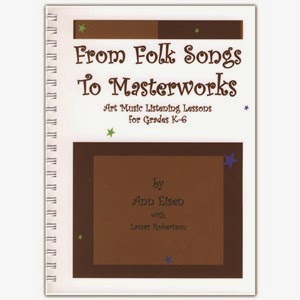
I always try to find a piece that clearly demonstrates the rhythms we are working on for my students to listen to. If you haven't yet seen "From Folksongs to Masterworks," I HIGHLY recommend you check out this resource. It has great listening connections to use!


31. Morse Code
In this game you have students work in pairs. A student taps a rhythm into their partners hand. Then the student who "received" the message tries to decode what they tapped.

Whew! Hopefully you gained an idea or two that you can take back to your students! Have a wonderful week!! 


1

Composer Books for a Sub


Hi everyone! This is Jamie Parker. I am so excited to post my first entry today! I have already gained a lot of new ideas from the other contributors, and I hope you have, too.

I have recently been out of the classroom for a few professional development days, and I had to do what most teachers dread: write sub plans.

When I have a substitute in my classroom, I have to assume that he/she has no musical experience. I try to keep my plans as simple as possible. I love to incorporate children’s literature into the music room, and I have found that composer storybooks work great for days when I am gone.

Listed below are a few of my favorites. They are all wonderfully written and have beautiful illustrations. If you click on the picture, you will be directed to Amazon where you can view the book more closely.

You can certainly use these books as an extension of a listening lesson or with a composer study. I just like to save them for those times when I know I will be out of the classroom.

1.    Ballet for Martha: Making Appalachian Spring by Jan Greenberg and Sandra Jordan 
 Ballet for Martha
I found this book when I was in the gift shop after a Chicago Symphony Orchestra concert. I took one look at it and had to buy it. It has beautiful watercolor illustrations and tells the story of creating the ballet, Appalachian Spring. I love how the story shares the importance of collaboration. Aaron Copland (one of my favorite composers), Martha Graham (the choreographer), and Isamu Noguchi (the set designer), had to work together to create their masterpiece. When I was looking at the book online, I also noticed that there is an audio version of the book available. I listened to the sample and noticed that they intertwined the music into the text, which I thought was a fantastic way of presenting the story.


2.    I, Vivaldi by Janice Shefelman
 I, Vivaldi
This biography is told as if written by Antonio Vivaldi himself. He tells how his love of music helps carry him through his struggles. The author and illustrator both do a wonderful job of representing the historical and social atmosphere of the Baroque period. Pair the book with Spring from The Four Seasons for a great listening lesson.


3.    Strange Mr. Satie by M.T. Anderson
Strange Mr. Satie
The text and illustrations in this book are just as quirky and entertaining as the music of Erik Satie. Written poetically, the story tells of Satie’s struggle to fit in in a “world of black top hats and stiff, starched collars and gloves and bows and curtsies.” In addition to the great introduction to French culture, I loved how the book mentioned the collaboration of Satie and Picasso during the making of Parade. What a great starting point in discussing the relationship between the arts!


4.    What Charlie Heard by Mordicai Gerstein
What Charlie Heard
This book introduces another one of my favorite composers: Charlies Ives. It is a detailed biography of his entire life, and the author does a fantastic job of explaining how Ives received inspiration for some of his most famous pieces. The illustrations in this book are simply outstanding!  Each page is colored from top to bottom with different sound effects. My favorite part is when Charlie hears two marching bands playing different tunes during a parade—perfect opportunity to listen to Country Band March (one of my favorites from Wind Ensemble). Again, this book can be purchased with an audio version containing the music of Charles Ives mixed with the text of the book.


5.    When Stravinsky Met Nijinsky by Lauren Stringer
When Stravinsky Met Nijinsky
I’ve been looking for a good children’s book on Igor Stravinsky for a while, and I was so happy to find this one. Like Ballet for Martha, this book tells of a great collaboration between a composer and choreographer. I just love when books make it easy for me to be cross-curricular! The book is a very tasteful representation of the Rite of Spring, from its creation to the riot that occurred on opening night.


I hope you found some new composer books to use in your classroom! Do you have any other favorites? I would love to hear about them. Please share in the comments below.

6
Back to Top